> For the complete documentation index, see [llms.txt](https://docs.safekey.be/llms.txt). Markdown versions of documentation pages are available by appending `.md` to page URLs; this page is available as [Markdown](https://docs.safekey.be/user-guides/backups/create-backups.md).

# Create Backups

{% hint style="info" %}
Before you **create a backup of your primary SafeKey**, it's best to get one or multiple backup SafeKeys so you can create identical devices.
{% endhint %}

{% hint style="danger" %}
**Warning if you generate a backup file with SafeKey Desktop Tool!**

Be aware that if you generate a backup file of your SafeKey device with the SafeKey Desktop Tool, you're only creating a backup of the internal storage and your encrypted shares (SSDP - only available on a SafeKey Pro) that are stored on it.

Connections for two-factor authentication and passwordless logins (FIDO2 - available on SafeKey One and SafeKey Pro) will not be included in a backup file generated with the SafeKey Desktop Tool.

To have a backup of your connections, you always need a second SafeKey device and manually connect it to all your preferred services as well. There's no way to automatically duplicate your connections.

Best practice is to always have at least two SafeKeys connected to a service for your two-factor authentication or passwordless logins.
{% endhint %}

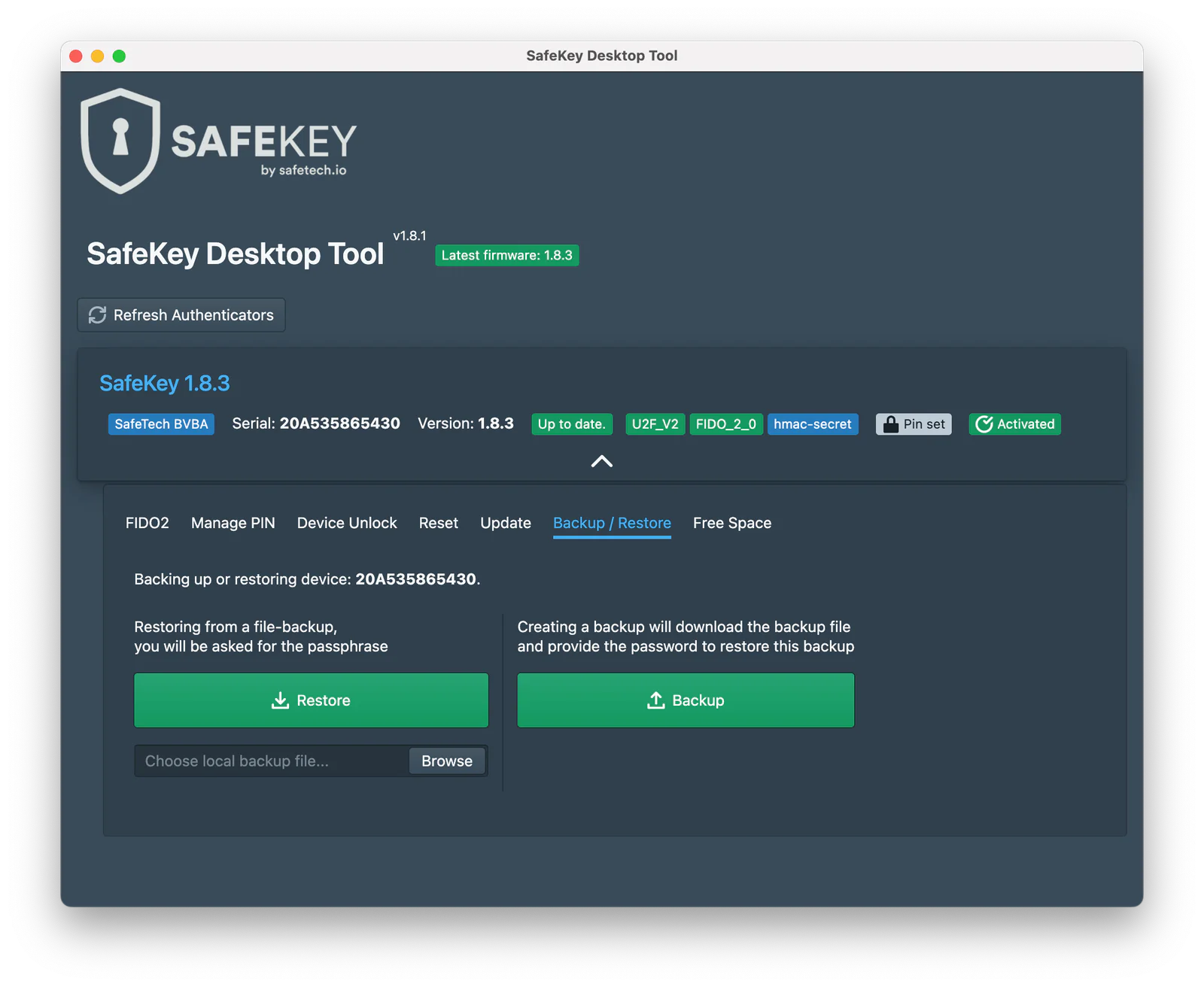
1\) Click on the **"Backup/Restore"** **tab** and then on the **green** **"Backup"** **button**.

<figure><img src="/files/3ZrOe5yS26Z62ZykfAbN" alt=""><figcaption></figcaption></figure>

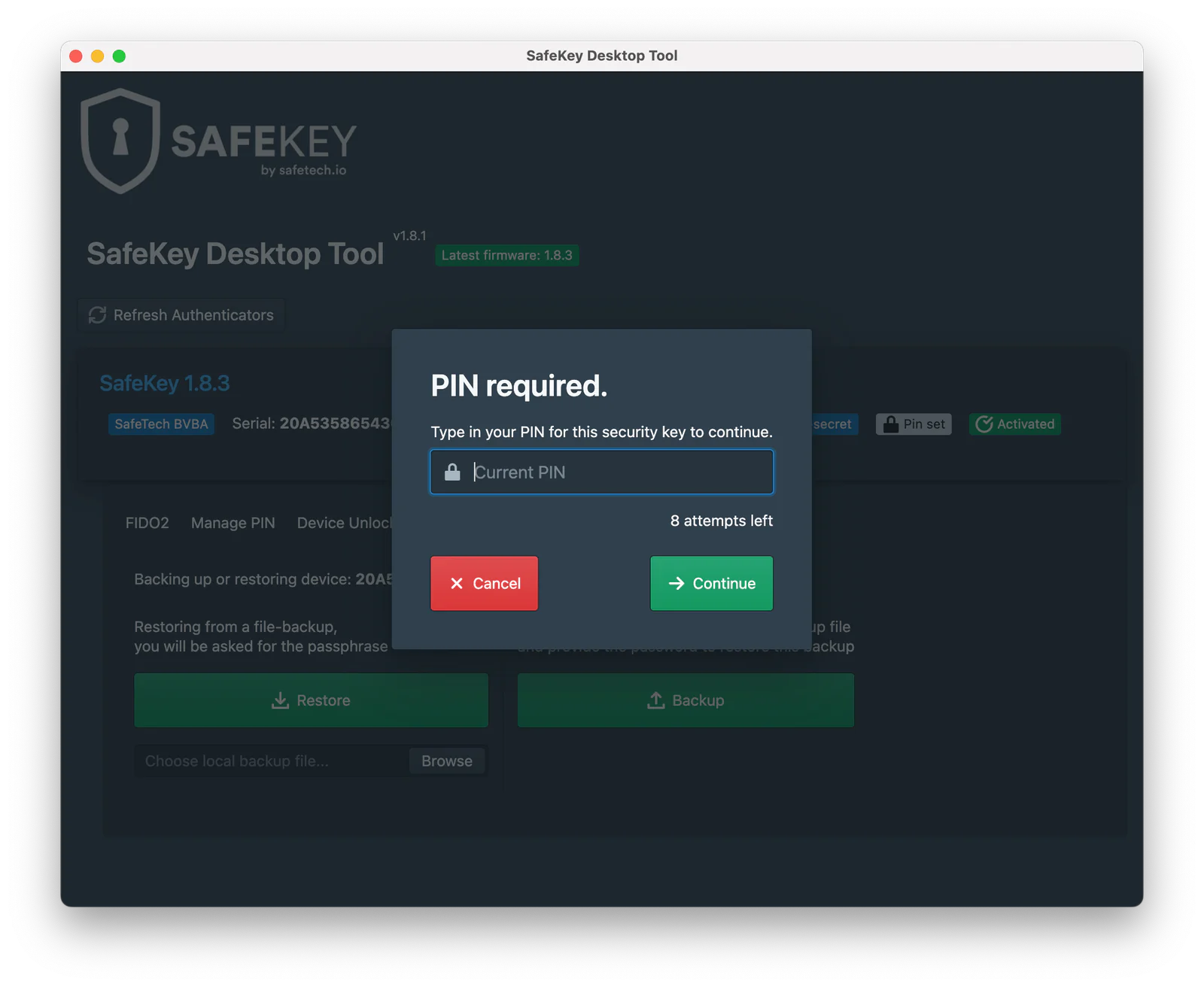
2\) If you've already [set a PIN code](/user-guides/pin-code-management.md) for your device, you'll have to enter it first.
<figure><img src="/files/q3mCur6uxHELfi7i8zN1" alt=""><figcaption></figcaption></figure>

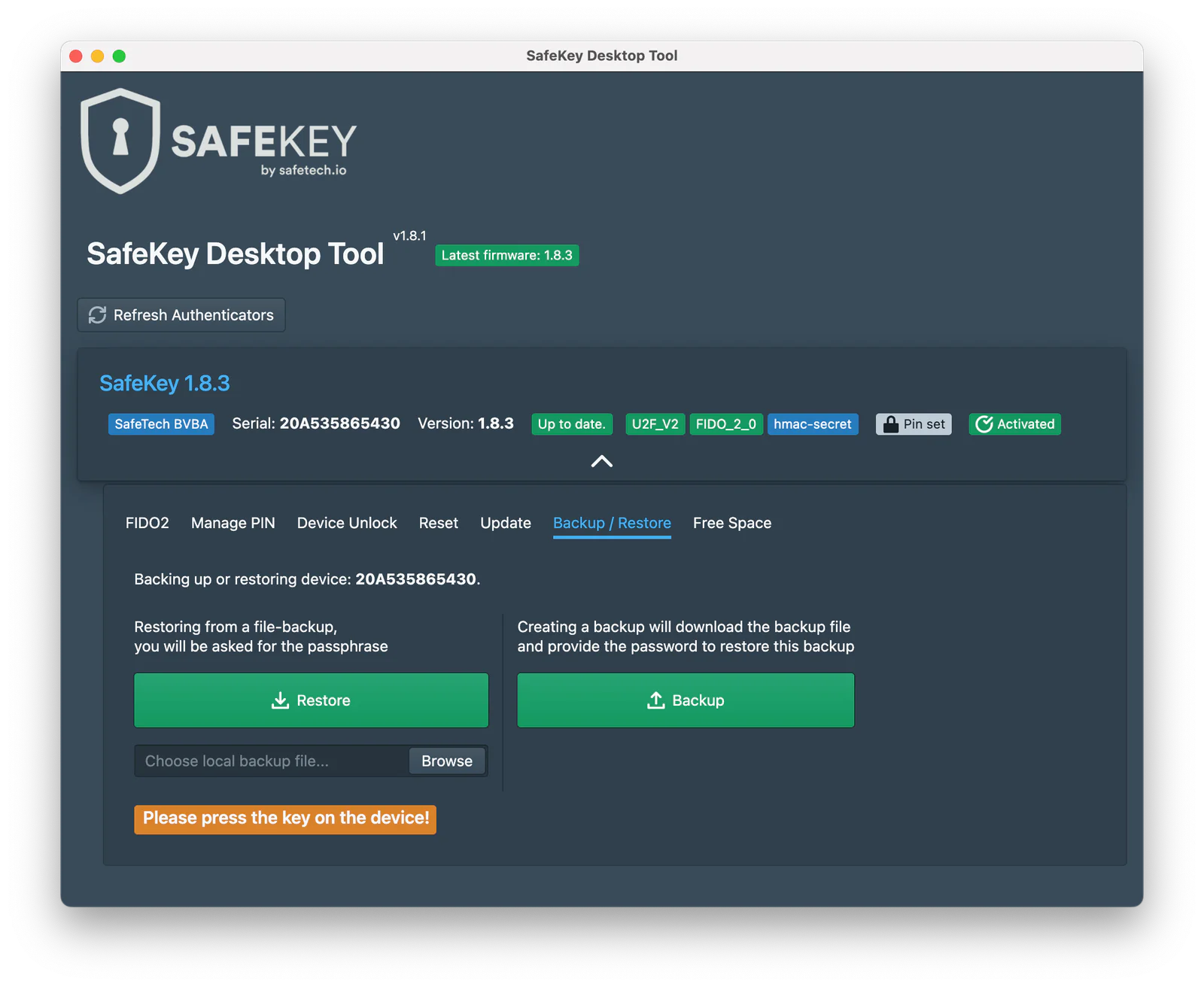
3\) **Touch your SafeKey** to verify the connected device.

<figure><img src="/files/jwk4Jybd3NJZa2mk2JMm" alt=""><figcaption></figcaption></figure>

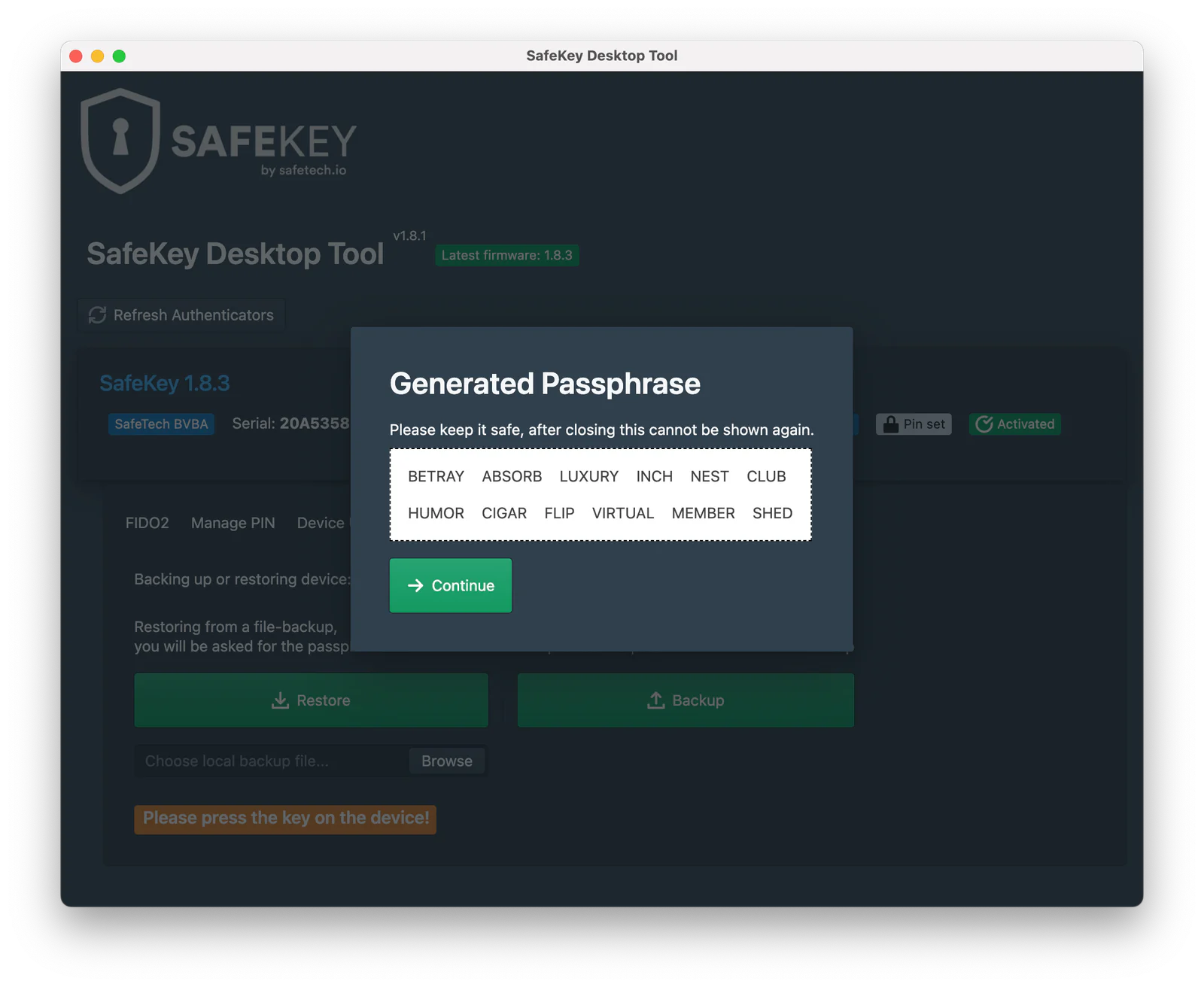
4\) You'll be prompted a **generated passphrase**.

This passphrase, consisting of 12 secret words, is used to protect your backup file that will be exported in the next step.

Please keep the generated passphrase safe since it will only be shown once and you'll need this passphrase to restore the backup on a later moment.

Click on the **green "Continue" button** if you've safely stored the passphrase.
<figure><img src="/files/QgUwaejE2Kdy2GSSrqQm" alt=""><figcaption></figcaption></figure>

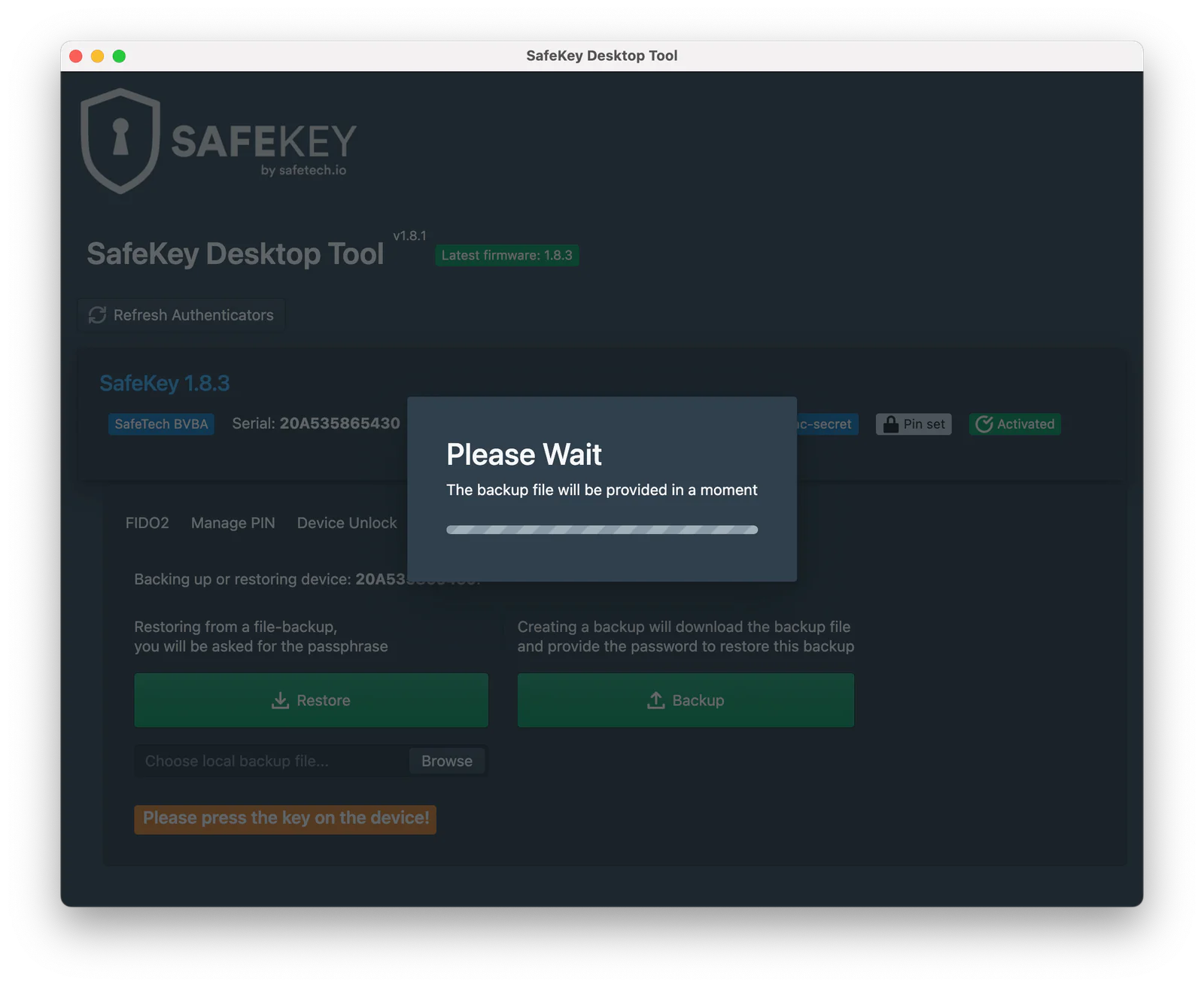
5\) Your **backup** file (a .dat-file) is **being generated**.

<figure><img src="/files/7gFQy1t1nFj3Ol7VUnTm" alt=""><figcaption></figcaption></figure>

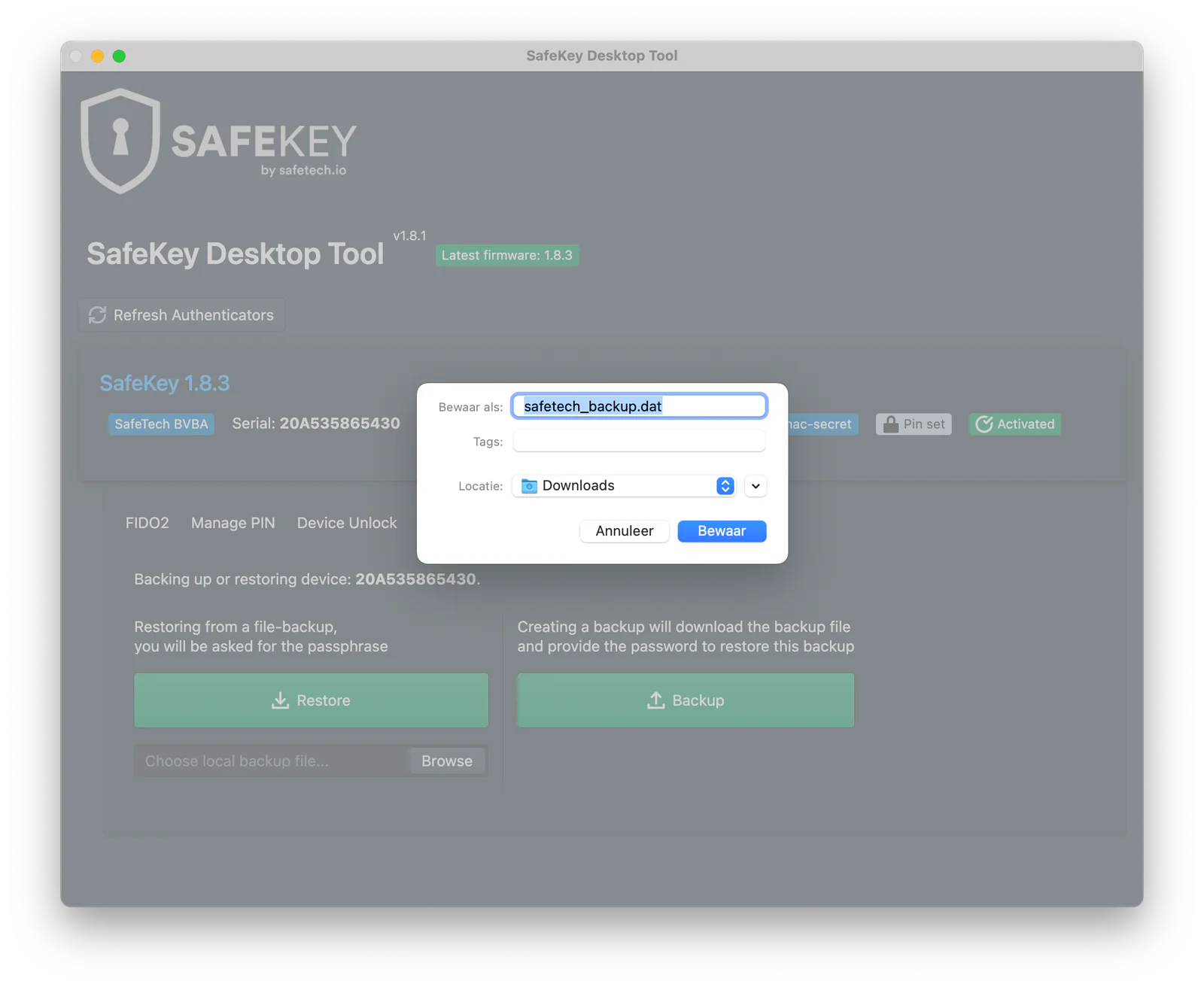
6\) Once your **backup is ready**, you'll be asked to **save the .dat-file on your computer** or another storage device.

This .dat file contains your backup, protected by the generated passphrase, and **can be used to restore your SafeKey device** in the future.

<figure><img src="/files/muylVdAQGpZdJnWvLKga" alt=""><figcaption></figcaption></figure>


---

# Agent Instructions
This documentation is published with GitBook. GitBook is the documentation platform designed so that both humans and AI agents can read, navigate, and reason over technical content effectively. Learn more at gitbook.com.

## Querying This Documentation
If you need additional information that is not directly available in this page, you can query the documentation dynamically by asking a question.

Perform an HTTP GET request on the current page URL with the `ask` query parameter, and the optional `goal` query parameter:

```
GET https://docs.safekey.be/user-guides/backups/create-backups.md?ask=<question>&goal=<endgoal>
```

`ask` is the immediate question: it should be specific, self-contained, and written in natural language.
`goal` is optional and describes the broader end goal you are ultimately trying to accomplish on behalf of the user. GitBook uses it to tailor the answer towards what is most useful for that goal.

The response will contain a direct answer to the question and relevant excerpts and sources from the documentation.

Use this mechanism when the answer is not explicitly present in the current page, you need clarification or additional context, or you want to retrieve related documentation sections.